Showing posts with label Car Maintenance. Show all posts

Thursday, October 6, 2011

That New Used Car

As I have never purchased a new vehicle only used I always make sure to do some basic maintenance for worry free operation. Recently I purchased a new to me 1996 Jeep Cherokee with the 4.0L inline six and 5 speed manual to replace my failing 1988 Bronco II. This is really a high mileage vehicle with 368,XXX on it and it actually runs really well. As I would like to keep it running as such I need to take care of it. Also by doing this maintenance I can get an idea of the care the previous owner took of the vehicle.

So what are the things I do to a used vehicle when purchased. It is basically fluids, filters, and depending on mileage spark plugs and wires as well.

  1. Engine oil and filter service - First thing is first check the oil level, it should be in the normal fill range, if not the engine might have an excessive leak or be burning oil. Then check to see that it is in the normal range of color (light clean tan to darker brown indicating it is time for a change) if it is really black they may not have changed the oil as regularly as they should have. If it is milky then there is either a head gasket leak that is causing coolant to leak into the oil or there is a plugged PCV valve/system. If you have milky oil hope it is just a plugged PCV valve otherwise return the vehicle if they didn't tell you it had a bad head gasket or valley pan gasket (not all vehicles have a valley pan). At this point I have all the info I can gather from the oil so I just do my normal oil and filter service even if the oil is reasonably fresh. This enables me to know exactly when the oil was changed and if there were any deposits you just flushed them out.
  2. Transmission fluid and filter if automatic - Most people neglect their transmission especially automatics. Here I check the level to ensure there isn't a leak and then change it. If it is an automatic you should change the filter as well and clean out the pan to remove any filings that are in there. Manual transmission don't have a filter but when changing fluids always open the fill plug before opening the drain plug (this is a common theme). You do this to ensure that you can refill the thing before you empty out all the fluid. If I can't get a plug out (I have only had this happen once) I am willing to make it someone else's problem as a fluid change isn't that expensive on a manual transmission or differentials. Once they crack it open it will be easy the next time you want to do it and you won't have to pay someone else to do it this time. Fresh fluid and filter will greatly extend the life of an automatic transmission.
  3. Coolant - Here I check the level and also check to see if there is any oil in it. Once done I drain it and fill it back up with a 50/50 mix of distilled water and antifreeze. If you have oil in your coolant then you might have a blown head gasket or bad valley pan gasket. Use distilled water it doesn't have all the minerals that tap water has in it that can cause corrosion and lime scale build up and will extend the life of your cooling system.
  4. Transfer case fluid - check the level to ensure that it doesn't leak and then drain and refill. Again here always open the fill plug before opening the drain plug since you don't want to drain it and then not be able to refill it.
  5. Differential fluid - Again here check the level before draining and refilling to ensure that there isn't a leak. When changing it always remove the fill plug before removing the cover or drain plug to ensure you can actually refill it. Once the cover is off clean up the interior of the differential using paper towels to wipe out any material and remaining oil you can. You will need to scrape off any gasket material that may still be stuck to the differential or the cover. The nice thing is if they have been using different color RTV gasket material you can tell how many times it has been changed. It appears on my Jeep it has been done at least 2 times as there wasn't the factory paper gasket (this is all Jeep used) and there was some old orange RTV gasket material and newer gray RTV gasket material. Also you can check for excessive wear marks or scoring on the gears.
  6. Fuel filter - Who knows when this was last changed and they are cheep.
  7. Air filter - Even if it looks clean these are cheep and easy to do so might as well
  8. PCV valve - Again here it is cheep and really easy to change
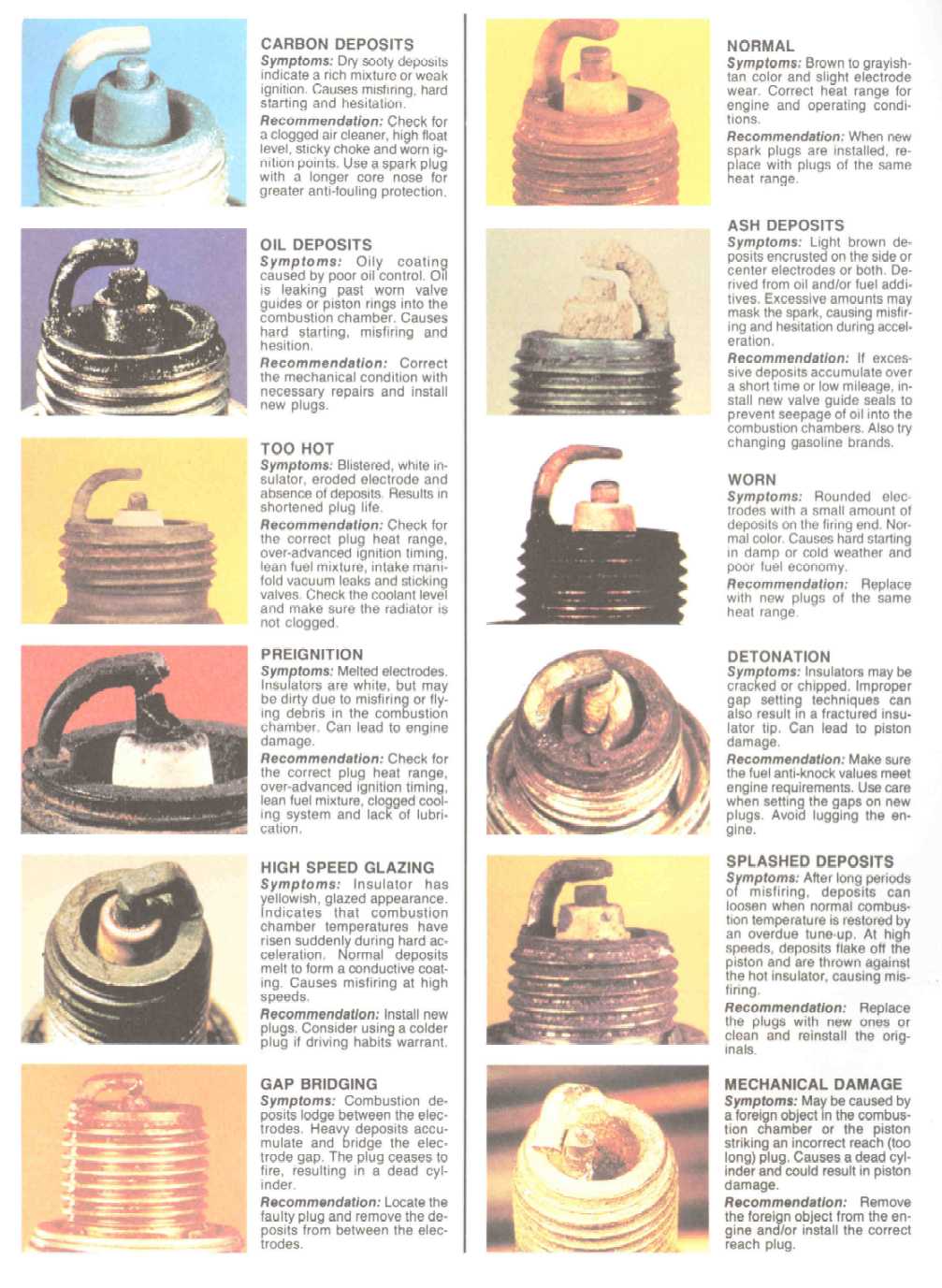
  9. Spark plugs and wires - With 368,??? on the Jeep the $12 in plugs and $14 for wires seemed reasonable. This also gives you a great insight into what is going on inside the engine and how it is running if you want to read your spark plugs (not my site but this diagram is a common one and is correct). Also since this Jeep still has a distributor I also changed the cap and rotor as they looked to be the factory originals and I didn't want to get stuck for the $11 it cost for new ones. It is cheap insurance and you are already working in that area of the vehicle.
  10. Power steering fluid - This also seems to be a neglected fluid much like transmission fluid is. I always do a partial exchange when changing oil so might as well get some clean fresh fluid in there. Just use a fluid transfer pump to empty the reservoir and refill with clean fresh fluid. You probably only change out 1/3 to 1/2 of the fluid but do this a few times and you will be near all new fluid in your power steering system.
Additionally I give the vehicle a good once over checking all the belts and hoses to ensure that they aren't in need of replacing if you find one that needs replacing do it now not later, road side repairs suck and tows are expensive. Also at this point I will convert a vehicle to fully synthetic fluids for all their added benefits. Now that most things have been done and you know when they have been done you can just follow a regular maintenance schedule and hopefully have years of worry free operation. 

Sunday, July 10, 2011

Minimize the cost per mile driven

With fuel prices rising again, oil is back near $100 a barrel, you will probably want to minimize your cost of driving. Some helpful hints are common ones, but others are some lesser know things. One thing I have discovered in my years of working with cars and being around the car culture is that there are similarities between vehicles that get really good mileage and high performance vehicles.


1. Proper tire pressure
Keep your tires properly inflated. This will help decrease the rolling resistance (friction between your tires and the road) increasing fuel mileage. The higher tire pressure you have the lower rolling resistance between them and the road. While it may sound good to just crank the pressure way up this isn't a good thing either as it will affect the ride quality, tire wear, and safety.


2. Clean your car out
Not only will your friends want to ride in your car you can cut your fuel consumption. Granted in most cases this won't amount to much if any but if you carry around a bunch of junk (10's to hundreds of pounds) there might be a noticeable difference.


3. Keep your vehicle tuned
By keeping your vehicle properly maintained you can keep it running as efficiently as possible. See my previous posting on a vehicle maintenance schedule. Not only will this schedule keep your car running for a long time it will keep it running optimally.


4. Fuel saving tires
Fuel saving tires can help reduce your fuel consumption as they offer lower rolling resistance between your tires and the road.


5. Decrease drag
Remove external accessories for your vehicle. Just as cleaning out the junk can increase fuel economy so can removing unneeded exterior accessories. Typically this will be things like roof racks, bike racks, hitch accessories. Not only are you decreasing the weight of your vehicle, but you are decreasing the amount of drag caused by the wind hitting these things.


6. Use the correct gas
People seem to think that using premium gas will increase their fuel economy, the truth is if your vehicle is running correctly it won't. The truth is your vehicle was designed to run on gasoline with a specific octane (typically 87, 89, or 91). Granted using a higher octane won't hurt your car, but it does cost more money. By running a lower octane fuel in your car than recommended in you will waste fuel. This is because modern cars can compensate for too low of an octane by dumping more fuel in. This will prevent preignition, but will cause your car to run rich and will shorten the life of O2 sensors and catalytic converters. The truth is gasoline regardless of octane contains the same amount of energy.


7. Use synthetic fluids
Synthetic fluids can help increase your fuel economy. Granted they are more expensive, but they last longer. I cover synthetic oils in detail in this post. In my daily driver I run synthetic oil in the engine, synthetic transmission fluid in the transmission, and synthetic gear oil in the read differential. Most of the benefits of synthetic fluids come from the superior lubrication, decreased friction, and better flow, it takes less energy to move them around.


8. Use lighter oil
You can get better fuel economy by using a lighter oil. In my daily driver I run 0w30 in the cold Minnesota winter and then work up to 10w40 in the summer using either 5w30 or 10w30 in the spring and fall depending on temperature. As temperatures warm you shooed be using heavier oils to protect your engine, but don't use a heavier oil than necessary.


9. Gas coupons
Not all states allow or have gas coupons but I know here in Minnesota several gas station chains have gas coupons. Both Kwik Trip and Holiday station stores have gas coupons in the St. Paul paper for up to 7 cents off a gallon. The Kwik Trip coupons are in the St. Paul paper on the first Wednesday of the month, and the holiday coupons are in the St. Paul paper on the last Wednesday of the month. Additionally you can sometimes find gas coupons online for gas stations like Holiday Station stores have.


10. If your car takes 89 octane some stations sell it at the price of 87 octane
If you are unlucky like me to have a car that takes the mid grade (89 octane) you are kind of stuck paying a higher price per gallon for gas unless you know what gas stations sell the mid grade (89 octane) at the same price as regular (87 octane). This can save between 7 and 12 cents a gallon. I know that the Kwik Trip stores near me do this as do a number of the Holiday gas stations.


11. Use gas that doesn't have ethanol in it
In Minnesota this is basically impossible, yes you can buy non-oxy fuel but it is few and far between, but I believe that some states still sell gas without ethanol. If you are in a state that has a 10% ethanol mandate you loose about 3-4% of your mileage because of the lower energy content of ethanol.


12. Leave some distance between you and the one in front of you
Now it is theoretically possible to get better mileage by following closely behind another one. This is because of decreased drag, but is also dangerous and rarely produces good results. The reason for this is that you are varying your speed more than you normally would. By leaving more space between you and the vehicle in front of you 12. Leave some distance between you and the one in front of you you may not have to overcome more wind resistance, but you will be able to drive at a more constant speed. Also in rush hour traffic you can gradually slow down and speed up when doing this. Quick starts and stops really wreck mileage.


For the most part I practice what I preach and doing these things can lead to significant gains in mileage. My daily driver is an 1997 BMW 540i with a 5 speed automatic transmission, sport package, and has 215,XXX miles on it. This vehicle was claimed by the government to get 18 MPG combined and qualified as a cash for clunkers vehicle, I have never gotten that poor of gas mileage. My rolling average over the last 114,000 miles or so (I got the vehicle with 101,000 miles on it) has been 22.7 MPG according to the on board computer. This is more or less what I see when I fill up but is definitely in the correct range. I drive 32 miles one way (64 round trip) to work each day in rush hour traffic plus all the other little BS trips I make in a week. The best mileage I have ever gotten has been on long trips that are mostly open road. Typically on trips these I get in the 27 to 29 MPG range and have gotten that several times, most recently was last weekend going up to the iron range and back averaging 28.2 MPG round trip on a trip that was just a little over 400 miles. I could probably get better mileage but I do like to drive in a rather um "spirited" fashion especially on freeway entrance and exit ramps.

Friday, July 1, 2011

Your check engine light is trying to tell you somethign

One thing that seems certain in older vehicles is that you will see the check engine light. I have seen a lot of people ignore this light as their cars appears to run as good as it ever has but truth is something is wrong. In most cases the check engine light is indicating some emissions related issue or a misfire, other times it could be indicating something much worse. The check engine light indicates that your engine is not running optimally and what ever is causing this should be addressed. Even worse is when your check engine light is flashing, you shouldn't be driving your car when this happens.

To find out the cause of the check engine light being on you will need a scan tool. If you don't own one that is fine as a number of auto parts stores loan them out, or will even do the scan for you. For more information on scan tools see this post of mine. Once you have the code (they have the form of P####, B####, or C####) you will need to figure out what it means. Some scan tools will tell you, but if the one you are using doesn't then you can find out what it means by:
  •  Looking it up in a repair manual for your car
  • Asking the clerk at the auto parts store
  • Looking it up online
If you are going to look it up online I suggest going to this site, or directly putting the code into a search engine like Google and including the make and model of your vehicle as well.You probably aren't the first person to have this problem with your vehicle so by searching for the error code and you make and model you can find out what others did to resolve the problem.

I do like asking the auto parts store clerks as they usually are knowledgeable and if you used their scan tool then you are there already. Sometimes they can provide a detailed printout of what the error code means which is even more helpful. Also you will probably need to purchase a new part anyway which is why the auto parts store lets people use the scan tool for free.

In my experience most codes are caused by old spark plugs (misfire), old O2 sensors (slow sensor, bad reading for a sensor, failed sensor), old spark plug wires or boots (misfire), or some failed sensor (throws a sensor failed code). The good news is that a lot of these issues can be avoided by following a maintenance schedule and replacing these parts before they cause a problem.

Finally in closing let me say that it is always a good idea to solve vehicle issues right away. The check engine light looks the same if you have one error code or 50, and with it on your vehicle is not running as well as it should and may be wasting fuel, polluting, or wrecking other parts without your knowledge.

Wednesday, June 22, 2011

5 Minute Car Care

Here are some basic car care tasks that take less than 5 minutes each.
  1. Change you wiper blades. Wipe blades wear out and need to be replaced every 6 months to a year. On most vehicles they just clip on. To make this job easier use a slotted screw driver to depress the little tab that holds them in place. The new ones just clip in.
  2. Change your air filter. Air filters need regular replacement so you car can perform at its best. This is a simple task that requires at most a screw driver. 
    1. Open the filter box, sometimes the filter box is held closed by clips, other times by screws
    2. Remove the old filter
    3. put the new filter in
    4. close the box, put the screws back in or redo the clips.
  3. Change you PCV valve if you vehicle has one. When the PCV valve gets plugged your vehicle will smoke a lot because it is sucking up oil.  This is really easy it only takes about 30 seconds and a new PCV valve is usually in the range of $3-$5. 
    1. Find the PCV valve (hint it is in the valve cover on the top of the engine and will look kind of like the new part you just bought)
    2. pull the old PCV valve out of the valve cover
    3. remove the hose attached to the old PCT valve
    4. connect the hose to the new PCT valve
    5. put the new PCV valve in the valve cover
  4. Check you tire pressure. This will maximize your tire life, fuel mileage, and ride quality. The longest part of this fix is going to a gas station if you don't have your own compressor. You will need a tire pressure gauge and if you don't have one buy one it they are a couple of bucks.
    1. Go around to each tire and check the pressure (you can find the correct tire pressure in either your owners manual, on the drivers side door pillar, or the gas door)
    2. add some air if it is low or let some out if it is high, 
    3. recheck and add or remove air as necessary until at the correct pressure.
Doing all of these tasks is cheep, typically you could do all 4 of them for less than $15 if you didn't own anything and needed to buy a screwdriver, and tire pressure gauge. 

Sunday, May 22, 2011

The best oil change ever

Changing the oil on your vehicle is probably the single best thing you can do for it. Getting your oil changed isn't very expensive and doing it on a regular schedule will help to greatly extend the life of your vehicle. If you are in a pinch you can always take it to one of those oil change places and and get it done in 30 minutes or less. This is better than nothing and if more people would do this then they would have fewer issues with their cars. Personally I don't really like these places as they don't seem to do a very good job and I keep hearing horror stories of them stripping out the threads on the oil pan so I just do my own oil change.

Benefits of doing your own oil change:

  1. It is done correctly
  2. Cheaper
  3. You can take care of other things as well
Mandatory Supplies:
  1. Oil (probably between 4 and 8 quarts). If you don't know how much you need, or what type ask at you local auto parts store, they are helpful. I prefer O'Reilly because they are close and seem to have most of the part I need. I recommend synthetic oil, grease, and other fluids as they are better.
  2. Oil filter. The people at the parts store can help you with this as well
  3. Funnel
  4. Hydraulic floor jack (don't use the crappy spare tire jack, those are junk)
  5. Oil drain pan
  6. Socket set or wrench set (you will need the size that fits the oil drain plug)
Recommended additional supplies:
  1. Power steering fluid
  2. Grease gun
  3. Fluid transfer pump
  4. Synthetic Grease
  5. Antifreeze
Steps:
  1. Drive the car around until it is fully warmed up. This will make it so the the old oil drains out quicker. Additionally this will get all the crud in the oil in suspension so it will be carried away with the old oil.
  2. Open the hood
  3. take off the oil filler cap
  4. Jack the car up (use one of the jack points for changing the tires)
  5. put the drain pan under the oil drain plug
  6. Remove the oil train plug
  7. Do these optional (recommended) steps as the oil drains out as the oil draining will take a while (probably close to 30 minutes)
    1. put the battery on a charger (trickle charge ensures that the battery is fully charged)
    2. using the fluid transfer pump remove all the fluid in the power steering reservoir. (cheeper to replace the fluid a little at at time than to pay for a new power steering pump)
    3. refill the power steering reservoir with fresh fluid (probably close to 12 ounces)
    4. grease all suspension parts using synthetic grease (makes these parts last longer. These are expensive)
    5. Shake the dirt out of your air filter (this will help extend its life)
    6. Check to see that your belts aren't cracked or worn (you don't want to get stuck somewhere)
    7. Check the radiator hoses 
    8. Check the tire pressure (don't want to get a flat)
    9. Check your coolant level (refill as needed, you don't want to run low on coolant as a blown head gasket will probably be the end of you car)
    10. Fill your windshield wiper fluid.(you want to see don't you?)
    11. Check lights and blinkers (this avoids a visit from a L.E.O.)
    12. Take the battery off the charger
  8. Now that the oil has finished draining out put the oil plug back in. Initially put it in finger tight (several full turns) then use a wrench or socket to tighten it down the rest of the way. This will prevent you from stripping the threads on the oil pan.
  9. move the oil drain pan so it is under the oil filter.
  10. Remove the oil filter and put it in the oil drain pan (more oil will drain out)
  11. Fill the new oil filter with oil (This will get oil into the engine quicker when you start it)
  12. put a light coat of oil on the rubber gasket on the oil filter (This will make it so you can easily get it off when you change it next time)
  13. Put the new oil filter on. once it makes contact with the engine turn it another 1/4 to 1/2 turn. this will keep oil from leaking out.
  14. Take the oil drain pan out from under the car
  15. Take the car off the jack
  16. Put the funnel in the oil filler hole and pour in the correct amount of oil.
  17. Put the oil filler cap back on.
Congratulations you have just done the best oil change ever. I do all of this each time I change oil on any of my vehicles. At this point you are stuck with some old oil, an old oil filter. Some auto parts stores will take the old oil and filter, but if not you can always dispose of them at the local hazardous waste disposal site. In Dakota county MN it is free. My local O'Reilly store take used oil so I just save up the old filters and bring a bunch of filters to the Recycle center at once (about 3 or 4 times a year).

Note* I am NOT sponsored by or in anyway affiliated with O'Reilly auto parts, I do NOT own stock in O'Reilly either.  I have had better experiences there than at any of the other auto parts stores so that is what I am basing my recommendation on.

Sunday, April 10, 2011

Maintenance Schedule

One of the best things to do for you car is to follow a maintenance schedule. By doing regular maintenance on you vehicle you keep it running at its best and can also find little issue before they become big issues. Additionally by following a regular maintenace schedule you can greatly exten the life of your vehicle. Almost every vehicle I have ever owned has made it well over 200,000 miles with the exception of my last car which got totaled in an accident at 179,000 miles. I have only had 2 vehicles die and both were cheep junk from the 80's that were in pretty bad shape when I got them but even they made it over 200,000 miles, the others were taken out in accidents but were still running great.

I am frequently asked by people when they should have things done on their vehicle and usually provide the same maintenance schedule I follow. I have attached the schedule here as a Google Docs, OpenOffice, and MS Excel spreadsheets. This schedule is on the aggressive side but will allow for some slack and oopses like not being able to get your oil change right on time.

If you need an office program I would suggest using OpenOffice which is a free open source office suite that is similar to MS Office. You can download OpenOffice here for free: OpenOffice download page